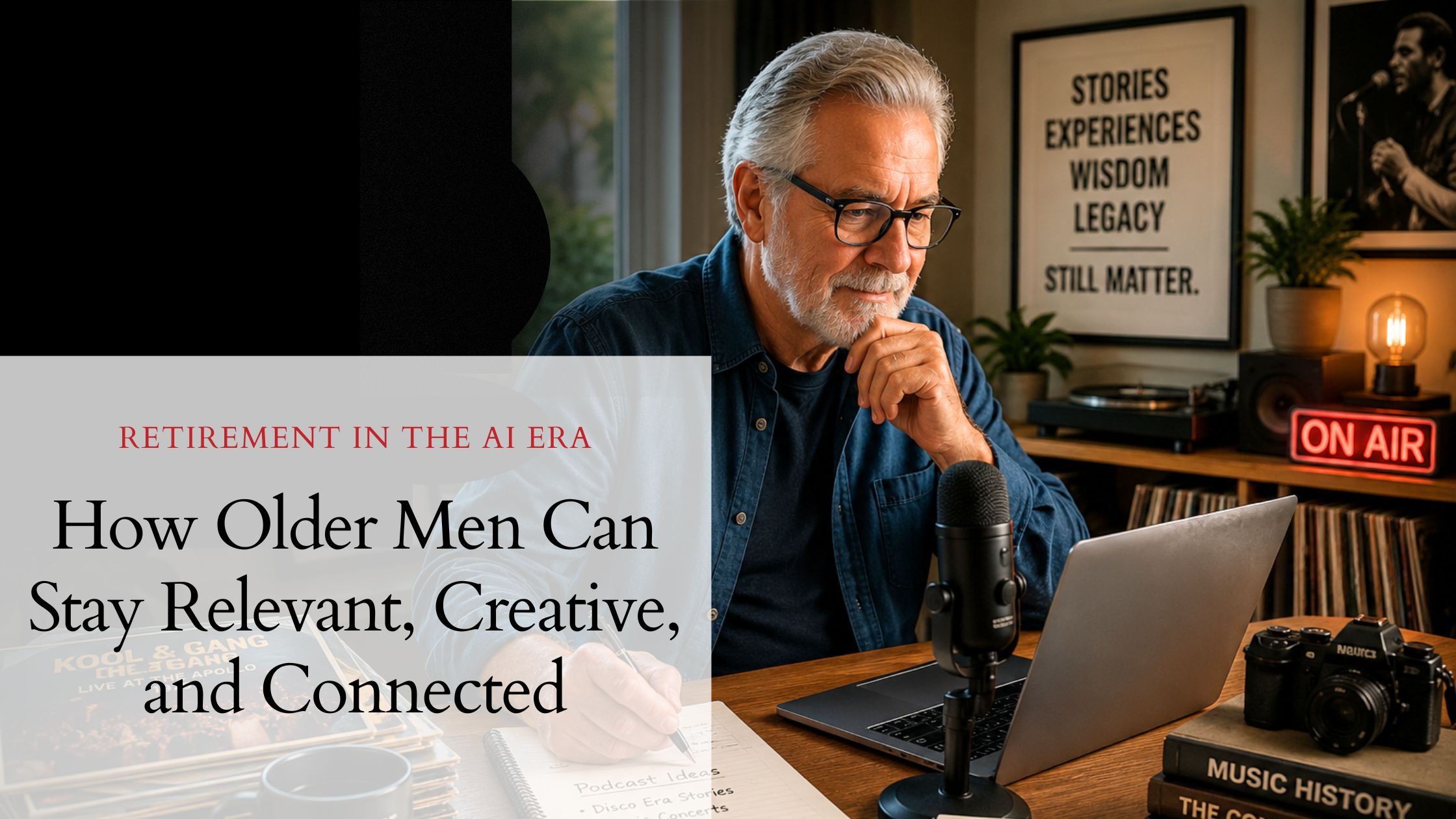
Retirement Identity Loss in the AI Era: How Older Men Can Stay Relevant, Creative, and Connected
Avoiding Retirement Identity Loss
For decades, retirement was marketed as the reward at the end of a long working life. A slower pace. Fewer responsibilities. More leisure.
But for many men, the reality feels very different.
The structure disappears. The phone rings less. Professional identity fades. Conversations become smaller. Days become quieter. Some men adapt well. Others slowly withdraw into routines that appear peaceful from the outside but internally feel empty, disconnected, or emotionally flat.
Families often notice it before the man does.
“He just sits there now.”
What is rarely discussed is that retirement is not only a financial transition — it is often an identity transition. For generations of men who spent 30–50 years being valued primarily for their profession, retirement can create an unsettling question:
“Who am I now that I’m no longer needed at work?”
But something important is changing.
Technology — particularly AI, digital platforms, online communities, and creator tools — is opening entirely new paths for older adults to remain intellectually engaged, socially connected, and culturally relevant long after traditional retirement age.
For many retired men, the future may not be about “slowing down.”
It may be about evolving into a new role altogether.
The Hidden Challenge Behind Retirement
Many men from older generations were raised with deeply ingrained beliefs about work, masculinity, and value.
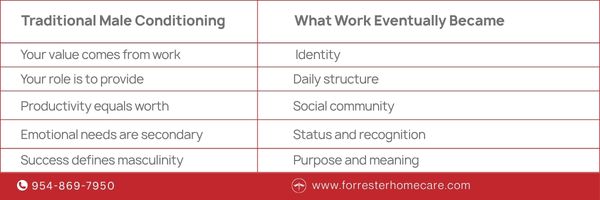
A man may have spent decades as a lawyer, pilot, engineer, businessman, contractor, executive, physician, police officer, or entrepreneur.
Then suddenly, one day, he becomes:
“Retired.”
That single word can quietly erase an entire social identity.
This is why retirement adjustment is often not simply about money or free time. It is about continuity of meaning.
The men who thrive after retirement usually replace work with something else that still provides usefulness, challenge, contribution, recognition, community, and mental stimulation. The men who struggle often lose all of those at once.
Why Traditional Retirement Advice Often Falls Short
For years, retirement advice focused heavily on passive hobbies such as golf, television, fishing, cruises, and relaxation.
There is nothing wrong with leisure. Rest matters.
But endless leisure alone is rarely enough to sustain long-term psychological wellbeing.
Human beings — especially people who spent decades building careers, solving problems, leading teams, or shaping organizations — still need engagement, stimulation, relevance, expression, and contribution.
Many retired men do not necessarily want to stop thinking, teaching, building, debating, organizing, or creating.
They simply need a new arena.
And this is where modern technology changes everything.
The AI Era Is Creating New Possibilities for Older Men
For the first time in history, retirees have access to tools that allow them to publish ideas globally, build niche communities, teach online, host discussions, preserve life stories, mentor younger generations, create podcasts and videos, and share expertise at scale.
Most importantly, many of these opportunities no longer require advanced technical skills.
AI tools can now assist with:
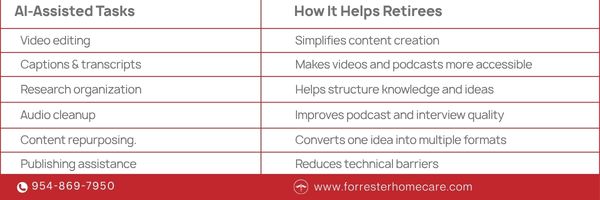
A man who once needed a production team can now build meaningful digital projects from home with relatively little friction.
This creates a powerful opportunity: retirement can shift from withdrawal into independent contribution.
The Rise of the Digital Elder
Modern culture often treats aging as decline. Yet older adults possess something algorithms cannot replicate: lived experience, long-term pattern recognition, historical memory, wisdom earned through mistakes, emotional nuance, and perspective developed across decades.
In previous generations, elders passed knowledge through local communities and family structures.
Today, digital platforms allow that knowledge to travel far beyond the neighborhood.
A retired man can evolve into a mentor, commentator, historian, storyteller, educator, community builder, archivist, interviewer, or cultural curator.
And increasingly, younger generations are searching for exactly this kind of authentic voice.
Across industries, many retirees are discovering that the skills, stories, and expertise built over decades still hold enormous value in the digital age.
Not every retiree wants to become a creator, commentator, or digital entrepreneur — and they do not need to. The broader point is that today’s retirees have more avenues for meaningful participation than previous generations ever did.
The Retired Music Lover Who Found a New Audience
Imagine a man approaching retirement who spent decades immersed in music culture — attending legendary concerts, organizing local disco events, collecting stories, and experiencing eras younger generations never witnessed firsthand.
Traditionally, retirement advice might suggest:
“Listen to more music.”
But modern technology allows something far more meaningful.
He could become a digital music storyteller.
He might start a YouTube channel discussing iconic concerts, host a podcast about disco culture in the 70s and 80s, create curated Spotify playlists with commentary, livestream themed music nights, interview local musicians and DJs, or produce storytelling videos about nightlife history.
These projects preserve memory, identity, social connection, and creative energy while also creating meaningful intergenerational engagement.
Younger audiences increasingly value authenticity, nostalgia, and firsthand cultural experiences.
A retired music enthusiast may have more cultural value than he realizes.
From Attorney to Public Thinker in the Digital Age
Now imagine a man retiring after 45 years as an attorney.
He is intellectually sharp, politically engaged, historically informed, comfortable with technology, and highly experienced in writing, argumentation, and analysis.
In the past, retirement may have meant professional disappearance.
Today, he could evolve into a digital public intellectual.
Modern opportunities might include launching a political analysis newsletter, creating legal explainers on YouTube, hosting constitutional commentary podcasts, writing AI-assisted essays, moderating online discussion salons, mentoring younger professionals, or publishing long-form commentary on social issues.
Many people today are exhausted by outrage-driven media. There is growing demand for calm, intelligent voices capable of nuanced explanation.
Older professionals are uniquely positioned to fill that role.
AI tools can now help summarize legal cases, organize research, repurpose articles into videos, generate outlines, edit transcripts, and streamline publishing workflows.
The result is not replacement of expertise — but amplification of it.
From Corporate Pilot to Aviation Mentor
After decades of operating under intense responsibility, precision, and structure, retirement can feel especially disorienting for pilots. Many corporate and commercial aviators spend their careers navigating complex systems, managing risk, traveling constantly, and carrying enormous professional responsibility.
Then suddenly, that identity disappears.
But digital platforms are now allowing retired pilots to continue contributing in entirely new ways.
Some are creating aviation YouTube channels, mentoring younger pilots online, discussing flight safety and aviation history, producing educational content, or sharing behind-the-scenes stories from decades in the air. Others are using podcasts, online communities, and digital training platforms to stay connected to the aviation world without the demands of full-time flying.
For experienced pilots, retirement no longer has to mean separation from the profession that shaped much of their identity.
It can become a transition from operator to mentor, educator, and storyteller.
The Difference Between Passive Aging and Active Contribution
One of the most important distinctions in healthy aging is the difference between passive consumption and active contribution.
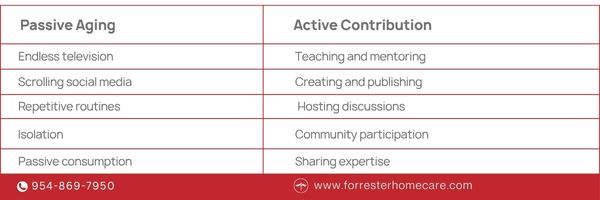
The human brain responds differently to contribution.
Purpose strengthens emotional resilience, cognitive engagement, social connection, motivation, and self-worth.
This does not mean retirement must become another stressful career.
It means meaningful participation still matters.
Why Families Should Pay Attention
Families often focus heavily on the physical aspects of aging — medications, appointments, mobility, nutrition, and safety.
But emotional and psychological health are equally important.
Many older men struggle silently because they do not want to burden others, were raised not to discuss emotions openly, associate vulnerability with weakness, or quietly fear becoming irrelevant.
Sometimes what appears to be stubbornness is actually loss of identity.
Adult children and spouses can help by encouraging projects connected to expertise, storytelling, mentorship, creativity, and community.
The goal is not simply keeping someone busy.
The goal is helping them remain engaged with life.
Practical Ways Families Can Support This Transition
Families can play an enormous role in helping older men discover modern avenues for contribution.
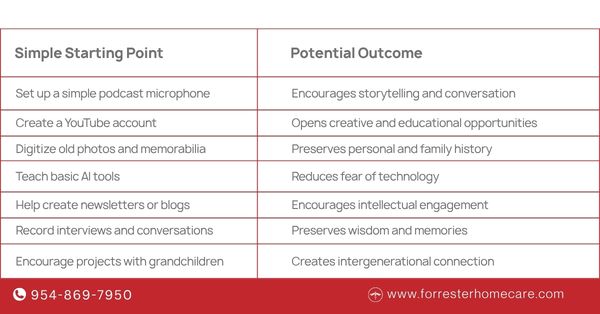
Many retirees do not lack wisdom or ideas.
They lack an accessible bridge into modern digital spaces.
Often, one supportive family member can make the difference between isolation and reinvention.
For many men, retirement is not only a financial transition — it is an identity transition. After decades of being valued for productivity, leadership, and professional expertise, many retirees quietly struggle with relevance, routine, and purpose.
Yet the AI era may also be opening the door to an entirely new phase of life — one where experience, creativity, mentorship, and digital tools create opportunities for contribution, connection, and even supplemental income.
In our next article, we explore how some retirees are building what could become a modern “second-stage economic identity.”
Retirement May Need a New Definition
For decades, retirement was framed as an ending.
But perhaps in the AI era, it can become something else:
a transition into mentorship
a return to creativity
a time for legacy-building
a chance to preserve knowledge
a period of independent contribution
a new form of relevance
The future of healthy aging may not revolve solely around helping older adults stay safe.
It may also involve helping them stay connected, expressive, useful, and intellectually alive.
How Forrester Homecare Supports Healthy Aging and Purposeful Living
At Forrester Homecare Fort Lauderdale, healthy aging is about more than physical care. Emotional wellbeing, purpose, social connection, and intellectual engagement also play a critical role in quality of life as people grow older. Through compassionate support and personalized care, Forrester Homecare helps older adults maintain independence, stay connected to the activities and people they love, and continue living with dignity, meaning, and purpose in the comfort of home.
You can learn more about Forrester Homecare’s approach to aging in place here:
Aging in Place at Home